


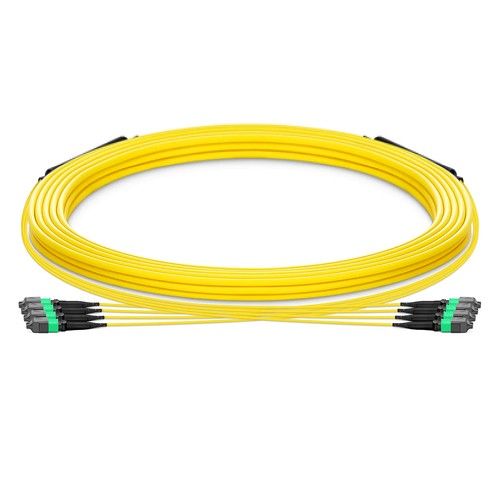
For Nigerian deployments, this product should be evaluated as part of the complete network path, including its connectors, mapping and acceptance values. This configured-to-order trunk cable builds 12 to 144 OS2 9/125µm G.657.A1 fibers into a double-jacketed armored assembly terminated with US Conec MTP Elite connectors. It brings the backbone-class 0.35dB maximum insertion loss of elite MTP terminations to routes that need real mechanical protection: between buildings, through industrial plant, or anywhere a trunk must survive the pathway instead of being protected by it. For Nigerian deployments, retaining this detail with the acceptance records supports consistent maintenance.
Product Highlights
- Insertion loss ≤0.35dB, 0.15dB typical per MTP mated pair
- Double jacket with helical steel armor; OFNP or LSZH
- Polarity Type A, B or C to the link design
- 200N long-term, 660N short-term tensile rating
- 12 to 144 fibers, Base-12 OS2 9/125µm G.657.A1
- US Conec MTP Elite connectors, female or male, APC
Specifications
| Connector A | US Conec MTP Elite, Female or Male |
|---|---|
| Connector B | US Conec MTP Elite, Female or Male |
| Polish Type | APC to APC |
| Fiber Mode | OS2 9/125µm |
| Wavelength | 1310/1550nm |
| Glass Fiber | G.657.A1 |
| Fiber Count | 12-144 Fibers (Base-12) |
| Polarity | Type A / Type B / Type C |
| Cable Jacket | Plenum (OFNP) / LSZH |
| Cable Structure | Double Jacket, Armored |
| Trunk OD | 4.5-14.2mm (by fiber count) |
| Breakout OD | 2.0mm |
| Breakout Length | 0.84m |
| Min. Bend Radius | 10mm |
| Insertion Loss | ≤0.35dB (0.15dB Typ.) |
| Return Loss | ≥65dB |
| Attenuation at 1310nm | ≤0.35dB/km |
| Attenuation at 1550nm | ≤0.21dB/km |
| Tensile Strength | 200N long-term / 660N short-term |
| Operating Temperature | OFNP: -10 to 60°C; LSZH: -10 to 70°C |
| Storage Temperature | OFNP: -10 to 70°C; LSZH: -20 to 70°C |
Armored trunk cabling for backbone links
Backbone trunks cross the most hostile pathways in a facility: riser shafts shared with power, inter-building conduits, plant rooms with moving machinery. The double-jacket armored construction puts a helical steel tube around the fiber core, which means the backbone trunk carries the mechanical rating itself and the route does not itself depend on the condition of the conduit.
MTP Elite performance and the loss budget
Parallel-optic links chain several mated pairs, which means per-connector loss decides whether the channel closes. MTP Elite ferrules hold insertion loss to 0.35dB maximum with 0.15dB typical, roughly half the allowance of standard MTP terminations, which buys real headroom when the design stacks a trunk, two cassettes and patch cords end to end.
Polarity: Type A, Type B and Type C
MTP links must land transmit on receive, and the backbone trunk polarity is how that is engineered. Type An is straight-through, Type B is reversed, Type C is pair-flipped; the matching choice is based on the cassette and duplex cord plan at the two cable ends. State the polarity method with the enquiry and the backbone trunk is built and labeled to match it.
Fiber counts from 12 to 144
Base-12 construction scales the same trunk design from a single 12-fiber tube to 144 fibers in a 14.2mm double-jacketed build. Breakout legs are 2.0mm at 0.84m as standard, with pulling eyes and alternative leg arrangements available on request for long or difficult pulls. For Nigerian deployments, retaining this detail with the acceptance records supports consistent maintenance.
Pulling and installation practices
Armored trunks pull like a cable, not like a patch cord: respect the 200N long-term limit, use the pulling eye option on long or conduit routes, and feed the backbone trunk rather than dragging it around bends. The 10mm minimum bend radius of the G.657.A1 core is generous, but the practical limit on site is set by the backbone trunk OD, which means plan sweeps rather than right-angle turns at each direction change.
Stock lengths and made-to-order sizes
Trunks are built to the route: typical orders run from 1m (3ft) hardware-room links to 30m (98ft) and well beyond for inter-building pulls. Give the measured route with allowance for vertical drops and service loops, and the factory confirms the build and packing for the stated length.
Inspection and test procedures
Each MTP termination is interferometry-checked for end-face geometry, and every finished trunk is 100% insertion loss and return loss tested on all fibers, with results shipped against the serial number. The 0.35dB maximum and 65dB return figures are verified per mated pair, and the armor and jacket are inspected over the full trunk length.
Ordering Information and Support
Send the fiber count, connector gender per end, polarity type, jacket rating, route length and any breakout or pulling-eye requirements. The factory returns a configuration drawing with the quotation, and production starts once the drawing is approved. For Nigerian deployments, retaining this detail with the acceptance records supports consistent maintenance. For Nigerian orders, our team can check the requirement before coordinating manufacture and international delivery.


