


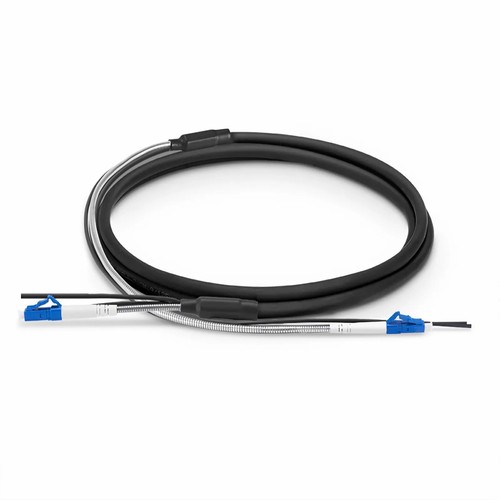
For Nigerian deployments, this product should be evaluated as part of the complete network path, including its connectors, mapping and acceptance values. This simplex FTTA patch cable carries a single OS2 9/125µm single-mode fiber from the baseband hardware to the radio unit, matching the single-fiber optics now common on tower-top radio units. It uses the same 7.0mm LSZH outdoor construction as the duplex FTTA family: Corning G.657.A1 bend-insensitive glass under an UV-stabilized jacket, with a helical steel armored branch protecting the exposed section at every end. The LC UPC interfaces plug directly into BiDi and single-fiber SFP modules used in LTE and 5G radio systems.
Product Highlights
- Corning G.657.A1 bend-insensitive fiber, 20/10D bend radius
- 7.0mm LSZH UV-stabilized jacket for outdoor exposure
- Helical steel armored branch against rodents and birds
- Stock lengths 3m to 50m; project lengths on request
- LC UPC to LC UPC simplex, OS2 9/125µm single mode
- Matches single-fiber BiDi optics on radio units
Specifications
| Connector Type | LC to LC |
|---|---|
| Polish Type | UPC to UPC |
| Fiber Mode | OS2 9/125µm |
| Wavelength | 1310/1550nm |
| Fiber Count | Simplex / 1 Fiber |
| Fiber Grade | Corning G.657.A1 |
| Min. Bend Radius (Fiber Cable) | 20/10D (Dynamic/Static) |
| Attenuation at 1310nm | ≤0.36dB/km |
| Attenuation at 1550nm | ≤0.22dB/km |
| Cable Jacket | Low Smoke Zero Halogen (LSZH) |
| Cable Diameter (Outer/Inner) | 7.0/2.0mm |
| Armored Breakout Length (End A/B) | 0.03/0.34m (0.2m optional) |
| Tensile Strength | 200/400N (Long/Short Term) |
| Crush Resistance | 1100/2200N (Long/Short Term) |
| Insertion Loss | ≤0.3dB |
| Return Loss | ≥50dB |
| Operating Temperature | -20 to 70°C (-4 to 158°F) |
| Storage Temperature | -40 to 80°C (-40 to 176°F) |
Single-fiber links on modern towers
A growing share of radio units use bidirectional optics that run transmit and receive on one strand. A simplex jumper matches that architecture exactly: one fiber, one connector at every end, no dark strand coiled behind the radio. Using a simplex cord instead of a duplex with one leg parked reduces weight on the tower, simplifies port allocation and removes the risk of a dangling unterminated leg collecting moisture or damage.
Mechanical protection where it counts
The exposed ends of an FTTA run take the real abuse: clamp pressure at the cable assembly entry, vibration from the structure, and wildlife along the route. The helical steel armored branch on this jumper absorbs that exposure while staying flexible enough to dress through glands and narrow tray entries. Because the armor is built into the branch rather than added on site, the protection is consistent from the first meter to the interface connector boot.
Bend tolerance for congested enclosures
Junction boxes at the tower base and the cable assembly entry at the RRU shroud leave little room for generous bends. G.657.A1 glass keeps attenuation stable at a 10D static bend radius, which means the patch jumper can readily be dressed into the available space without eating into the link loss calculation. The fiber remains fully compatible with fitted G.652.D feeder plant, which means the simplex jumper integrates into established single-mode infrastructure without re-engineering the link.
One jacket from shelter to antenna
Because the route usually begins inside a shelter or cabinet and ends outdoors, the LSZH jacket is specified for the two environments: low smoke and halogen-free behavior for indoor sections, UV and chemical resistance for the outdoor climb. A single continuous jacket means no transition hardware and one less potential failure point between the baseband hardware and the radio.
Stock lengths and made-to-order sizes
Stock length choices are stocked for fast delivery: 3m (10ft), 5m (16ft), 10m (33ft), 20m (66ft), 30m (98ft) and 50m (164ft), covering the common shelter-to-tower and frame-to-radio runs this cord is built for. Customized lengths beyond this range are manufactured to order. On single-fiber links the patch jumper length directly sets the slack stored at the RRU shroud; ordering the measured length keeps the fitting clean and avoids a heavy service loop hanging from the radio unit. Specifying the exact route length avoids the two the slack storage problem of an overlong cord and the strain risk of one that is too short.
Inspection and test procedures
Every simplex assembly is terminated with precision zirconia ferrule LC connectors and optically tested before packing. Insertion loss is verified against the 0.3dB ceiling and return loss against the 50dB minimum on each cord, and end-face geometry is inspected so the physical contact stays consistent across repeated mating during commissioning and maintenance.
Ordering Information and Support
Refer to the LC-LC simplex FTTA family at the request stage a quotation and state the route length. Where the radio or the baseband side uses SC instead of LC, or where a non-standard breakout is needed at one end, the made-to-order simplex FTTA program covers the same outdoor platform; send the requirement with the enquiry and the factory confirms the build before the build starts. For Nigerian orders, our team can check the requirement before coordinating manufacture and international delivery.


