


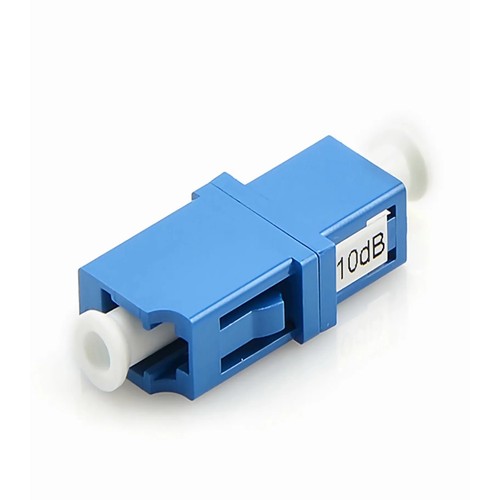
For Nigerian deployments, this product should be evaluated as part of the complete network path, including its connectors, mapping and acceptance values. LC/SC/FC/ST/LSH Single Mode Fixed Fiber Optic Attenuator inserts a precisely calibrated fixed loss into a fiber link. The attenuating element is ion-doped fiber - the loss is spectrally flat and reflection-free, unlike air-gap or offset designs - so the link sees exactly the rated attenuation at each operating wavelength. The female-to-female body works inline between two standard patch cords, adding attenuation without disturbing the interface connector plan of the plant.
Product Highlights
- Applied for CWDM, DWDM, Test Equipment, CATV Systems, Point to Point Systems, etc.
- Attenuating Material-ion Doped Fiber
- 1260 to 1620nm Wavelength Singlemode Attenuators
- Available in a Variety of Connector Types
- Standard Fixed Attenuation Values of 3/5/7/10/15dB
Specifications
| Connector Gender | Fixed Female to Female |
|---|---|
| Attenuation | 3/5/7/10/15dB |
| Operating Wavelength(nm) | 1260~1620(SM) |
| Operating Temperature Range | -25 to 70°C (-13 to 158°F) |
| Storage Temperature Range | -40 to 85°C (-40 to 185°F) |
| Application(1) | Length(1) |
Available Attenuation Values
This female-to-female attenuator is stocked in the standard inline values: 3dB, 5dB, 7dB, 10dB, 15dB. Each value is individually calibrated and marked on the housing.
3dB 5dB 7dB 10dB 15dB
Why links need attenuation at all
Optical links are engineered with a power budget: the transmitter launches, the fiber and connectors consume, and the receiver expects what remains inside a defined window. Short routes, dense wavelength plans and high-power transmitters might all deliver too much light, and an overloaded receiver distorts exactly like an overloaded amplifier - errors appear on a link that tests perfectly on loss alone. A fixed attenuator brings the received power back inside the window, and the link behaves as designed.
Ion-doped fiber as the attenuating element
The cleanest way to attenuate light is to absorb it inside the fiber itself. Ion-doped fiber attenuators do exactly that: a short section of doped glass absorbs a calibrated fraction of the optical power and converts it to negligible heat. Because the attenuation happens inside the core, the light that emerges keeps its mode profile and the device adds virtually no reflectance. The alternatives - air gaps, offsets and misaligned ferrules - all trade loss against reflections and modal noise, which is why precision attenuators abandoned them. For Nigerian deployments, retaining this detail with the acceptance records supports consistent maintenance.
Choosing the attenuation value
The right value is the difference between what the link delivers and what the receiver wants, plus a small margin. Measure or calculate the expected receive power first; then identify the nearest standard value - 1, 2, 3, 5, 7, 10, 15, 20 or 25 dB - that lands the receiver inside its window. Too little attenuation leaves the receiver overloaded; too much eats the margin that aging and repairs will need later. When the requirement sits between standard data, the made-to-order platform covers the exact figure.
Fixed values versus a variable instrument
Fixed attenuators win on stability, size and price: once the needed loss is known, a fixed device holds it permanently with no moving parts. Variable attenuators win when the loss itself is the question - receiver sensitivity testing, margin surveys, multi-wavelength leveling - where sweeping the value is the whole point. Most plants need the two: fixed units fitted in the links, and a variable instrument in the test kit.
Female-to-female inline attenuators
The female-to-female body sits between two standard patch cords like a coupler with a calibrated loss. That format suits test setups and temporary installations where the attenuator moves between links, and plants where the interface connector plan is fixed and the attenuation must be added inline. Either way, the attenuation value, not the gender, is what the link sees.
Return loss and the polish discipline
An attenuator sits in the middle of the link, which means its reflectance counts twice - once toward the transmitter and once toward the receiver. UPC versions hold return loss at 50 dB or better, and APC versions at 60 dB or better, which keeps reflected power far below anything a modern transmitter notices. The polish grade must correspond to the plant: an APC attenuator mated to a UPC connector through an adapter damages the two end faces and destroys the very return loss it was chosen to protect.
Handling and cleaning attenuators
An attenuator is a connector with optics inside, and connector rules apply: keep the caps on until the moment of mating, clean each end face before insertion, and never mate a contaminated ferrule into the device - the dirt transfers to the attenuator end face and the next connector that touches it. Store spare units capped and bagged, and record which link every fitted unit serves so replacement orders match the original value.
Selecting the right attenuator
Four decisions define the order: the attenuation value must correspond to the link calculation, the interface connector family must correspond to the port or the cords, the polish grade must correspond to the plant, and the body style - plug or inline - must suit the fitting. Fixed data cover permanent installations; the variable instruments cover testing; the test cable covers transceiver qualification. Getting all four right at order time is what turns a small component into a dependable part of the link.
Inspection and Test Procedures
Each attenuator is optically verified before packing: the attenuation value is measured at the operating wavelengths and checked against its rated tolerance, return loss is verified to its polish grade, and the interface connector end faces are inspected for scratches and contamination. Units ship capped and bagged.
Ordering Information and Support
Refer to this attenuator by attenuation value, connector family, polish grade and body style at the request stage a quotation. For data or configurations outside the listed options - non-standard dB figures, mixed connector pairings or project packing - send the requirement with the enquiry and the factory will establish the manufacturable specification. For Nigerian orders, our team can check the requirement before coordinating manufacture and international delivery.


