


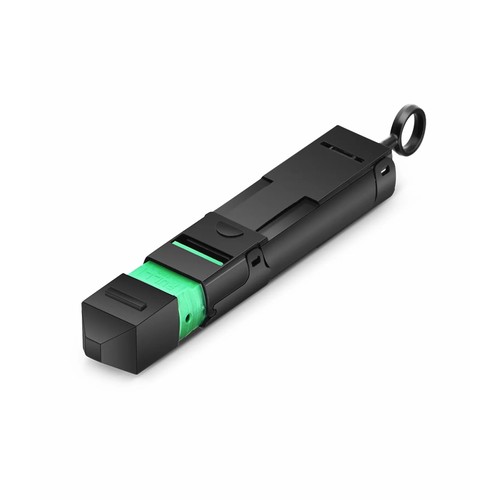
For Nigerian deployments, this product should be evaluated as part of the complete network path, including its connectors, mapping and acceptance values. This fiber loopback module provides a self-contained optical path that returns the transmit signal directly into the receive channel of the port under test: 12F, OS2, in a MTP configuration. Plugged into the interface, it lets a single technician validate transmitter output, receiver sensitivity and port allocation without a second device, a patch cord pair or a far-end loop.
Product Highlights
- Easy Insertion and Extraction with Push-pull Design
- Used in Testing 40G or 100G MPO/MTP® Interface Transceivers
- Designed for Troubleshooting Network Failure Nodes
- US Conec MTP® Connector
- Low Insertion Loss≤1.5dB, High Return Loss>50dB
Specifications
| Fiber Type | OS2 9/125μm |
|---|---|
| Fiber Connector | MTP® Female, APC |
| Insertion Loss | SM (G657.A2)≤1.5dB |
| Return Loss | SM>50dB |
| Insert-Pull Test | 50times, IL Change<0.5dB |
| Size | 80mm*10mm |
| Operation Temperature | -40 to 75°C (-40 to 167°F) |
| Housing Material | PC |
| Application(2) | Compatible Modules(2) |
Burn-in and production-line testing
Switch and transceiver manufacturers run loopback modules through thousands of insertion cycles on the production line: each port of each unit is exercised before this model ships. The insert-pull test rating on the test module reflects that duty - the housing, latch and ferrule are built to survive repeated daily mating without the insertion loss drifting beyond its specification.
What loopback testing actually proves
A loopback module closes the optical circuit inside one device: the transmitter launches light, the test module returns it, and the receiver must lock onto its own signal. When the link comes up clean under those conditions, the port has proven its transmitter power, its receiver sensitivity and its internal signal integrity in one step. It is the fastest way to individual a bad port from a bad cable plant, as the cable assembly plant is entirely removed from the test.
Testing parallel-optics transceivers
MTP-interface loopbacks serve the parallel-optics generations: 40G and 100G SR4-class ports on 8 fibers, 100G and 400G DR4-class ports on 12 and 16 fibers, and high-radix multimode interfaces on 24 fibers. The test module seats in place of the backbone trunk cable and returns each lane to its receiver, which means a full port test takes seconds instead of a cable plant and a far-end partner.
Male and female versions and when each is used
The gender of the loopback must correspond to the port under test: transceiver interfaces with guide pins expect a female module, and pinned trunk-side interfaces expect the reverse. Using the wrong gender does not itself merely fail to latch - it might damage the guide pins, which cannot be considered field-replaceable. The gender is marked on the housing; confirm it against the port before each insertion.
Parallel optics and per-lane verification
Parallel-optics interfaces carry many lanes on one connector, and a loopback test exercises all of them at once. Per-lane alarm reporting in the host system then points directly at any weak lane: a contaminated ferrule position or a damaged fiber shows up as a single lane failing while the rest pass. That granularity is what makes multi-fiber loopbacks more helpful than looping lanes one at a time with duplex cords.
Storing test modules between jobs
Between jobs the test module lives best in its original bag with the cap fitted, inside a closed kit box rather than loose in a pocket. Heat, dust and mechanical shock are the three enemies of a calibrated test tool; none of them announce themselves until a good port starts failing. A module that is stored properly and inspected before use gives the same trustworthy result on its thousandth insertion as on its first.
Sparing and kit planning
Loopbacks belong in each commissioning kit the way a known-good patch cord does. Plan one module per interface type per crew, plus a spare that stays sealed in its bag; the cost of an extra module is trivial against a truck roll to re-test a suspect port. Label every module with its interface, fiber count and attenuation so the right one comes out of the bag on the first try, and log its insertion count so a worn test tool never becomes the hidden cause of failing ports.
A bench test workflow that scales
The productive way to use loopbacks is a fixed routine: inspect the test module ferrule, mate it with the port, bring the interface up, record the per-lane status and the receive power, then unmate and cap the test module immediately. With the routine fixed, a technician qualifies a full chassis of ports in the time an improvised setup spends on one line card. The consistency also makes the records comparable - the same module, the same procedure, the same pass criteria across each site and each batch of hardware.
Selecting the right loopback for the task
Four decisions define the test module: the interface connector interface must correspond to the port under test, the fiber count must cover the lanes the optics use, the allocation type must pair the lanes the way the transceiver expects, and the attenuation must reflect the link loss calculation the test plan calls for. Getting all four right at order time is what turns a loopback from a drawer of adapters into a dependable instrument. When the requirement sits outside the standard configurations, the factory might establish a project-specific build - connector combinations, allocation variants and other attenuation data are all manufacturable options.
Inspection and Test Procedures
Each loopback module is optically tested before packing: insertion loss of the whole loop is verified against the specification, and the ferrule end faces are inspected for scratches and contamination. The test module ships with its dust cap fitted and the test result available on request.
Ordering Information and Support
Refer to the test module by connector interface, fiber count, polish and attenuation at the request stage a quotation. For other attenuation data, allocation types or connector combinations, send the test requirement with the enquiry and the factory will establish the manufacturable specification. For Nigerian orders, our team can check the requirement before coordinating manufacture and international delivery.


